
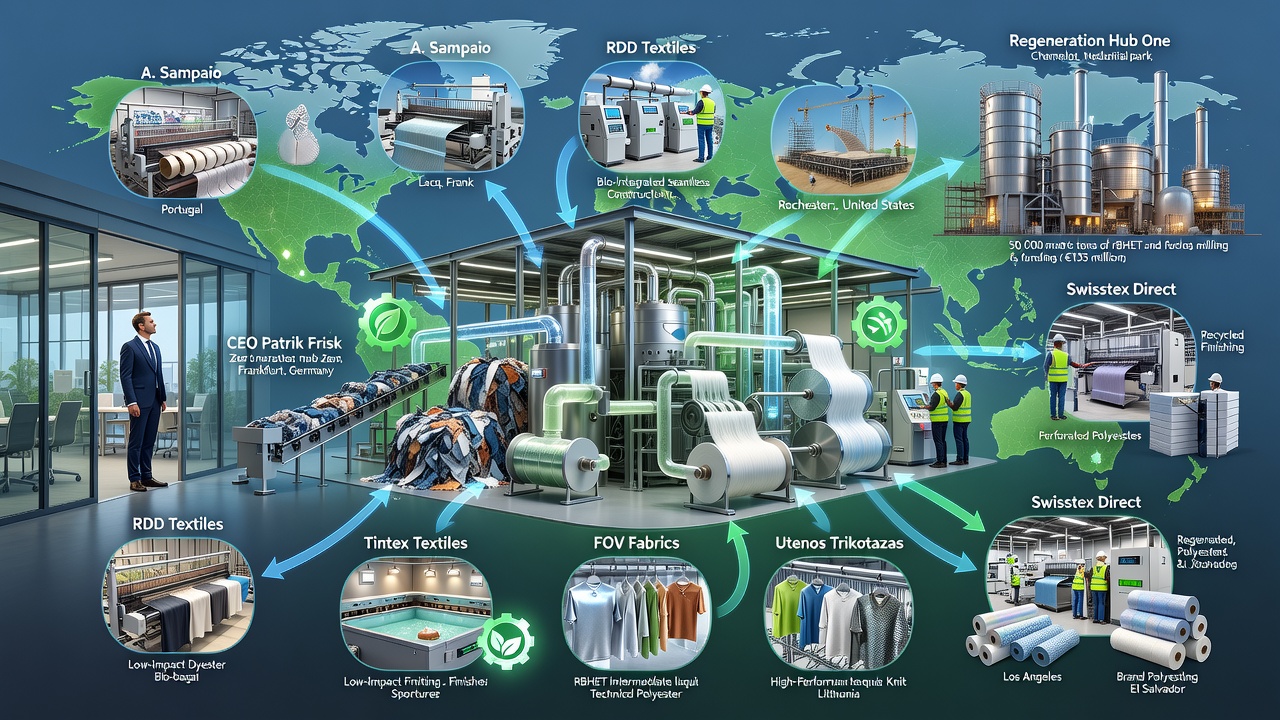
The French company Reju, owned by Technip Energies, has signed collaborations with six textile manufacturers in Europe and the United States. The goal is to turn its regenerated polyester into finished fabrics that brands can actually buy and use. The effort is a step toward moving textile recycling from pilot projects to industrial scale.
Who Is Involved and What Each Partner Brings
The network includes A. Sampaio, RDD Textiles and Tintex Textiles in Portugal, FOV Fabrics in Sweden, Utenos Trikotazas in Lithuania, and Swisstex Direct, which operates in Los Angeles and El Salvador. Each partner covers a different stage of production. A. Sampaio has more than 75 years of experience with circular-knit fabrics. RDD Textiles works with knitted and seamless constructions as well as recycled and bio-based materials. Tintex Textiles makes knitted fabrics for fashion, sportswear and lingerie using lower-impact dyeing and finishing methods. FOV Fabrics specializes in high-performance technical fabrics, Utenos Trikotazas is an integrated maker of knit fabrics and garments, and Swisstex Direct provides knitting, dyeing and finishing services for fashion brands.
Why Fabric Production Is the Harder Step
Recovering textile waste is only part of the challenge. The regenerated material also has to perform reliably in the machines and processes that manufacturers use every day. Reju's collaborations are meant to let it test the polyester across these industrial processes and meet the technical requirements of each manufacturer. CEO Patrik Frisk said each partner adds value to the company's circular textile system. The six partners are not recycling plants. They form a network of specialized manufacturers that could supply regenerated polyester consistently to brands worldwide.
The Recycling Process and Its Climate Claim
Reju is developing a chemical process that recovers polyester from post-consumer textile waste and converts it into rBHET, a chemical intermediate that can be repolymerized into new polyester. The aim is to reduce reliance on virgin polyester and build a textile-to-textile recycling loop. The company estimates its regenerated polyester produces about 50 percent fewer carbon emissions than conventional polyester. That figure is the company's own estimate and has not been independently verified in the supplied material.
Facilities and Remaining Milestones
Reju opened Regeneration Hub Zero in Frankfurt, Germany, in October 2024 as a pilot facility to develop and demonstrate its technology. Its next planned site, Regeneration Hub One at the Chemelot industrial park in the Netherlands, has a target capacity of 50,000 metric tons per year of rBHET and has received €135 million from the Dutch NIKI program. A final investment decision for that facility is still pending. The company has also selected future sites in Lacq, France, and Rochester, United States, so the project's scale will depend on whether these plans move forward.