
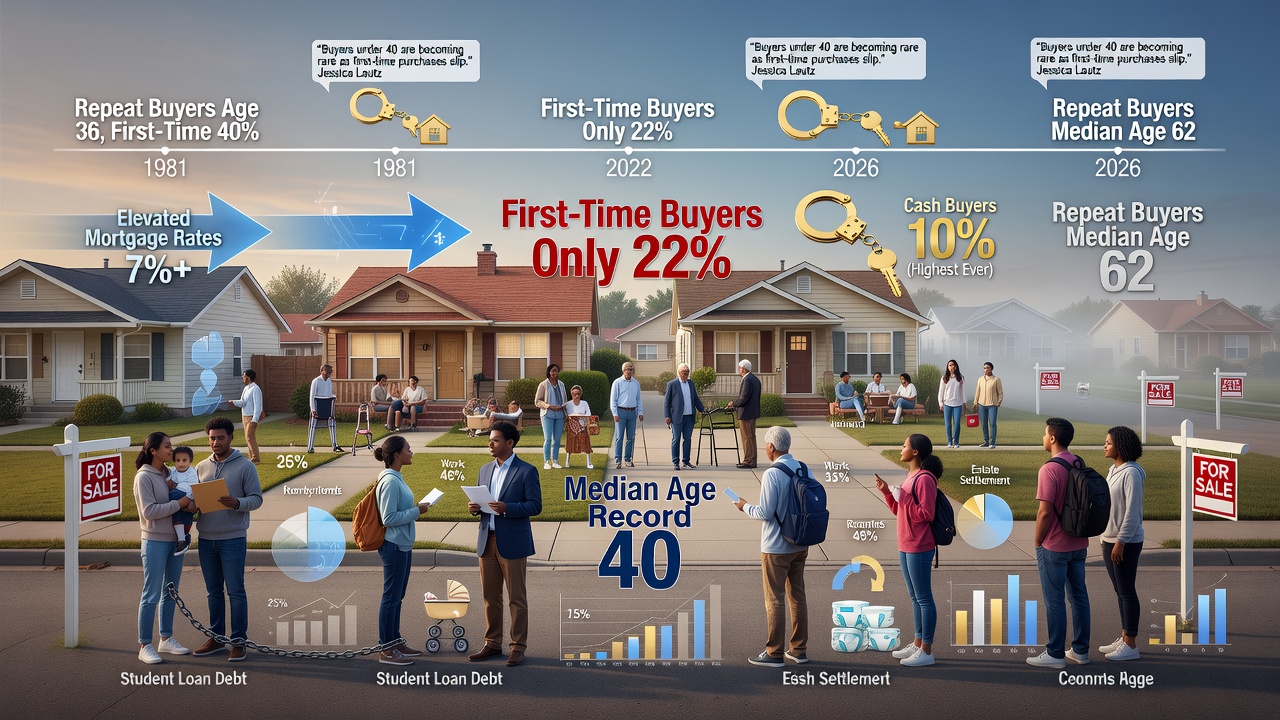
First-time buyers now make up 22 percent of home purchases, close to a historic low, and their median age has reached a record 40, according to the National Association of Realtors' 2026 Profile of Home Buyers and Sellers. The survey, drawn from transactions between mid-2025 and mid-2026, points to a market where limited affordable inventory and elevated mortgage rates keep newcomers on the sidelines.
Why First-Time Buyers Are Waiting Longer
NAR deputy chief economist Jessica Lautz said a brief dip in mortgage rates improved affordability only for a short time, and the first-time share edged up slightly from its low point. Many would-be buyers are still struggling to save for a down payment. Before the Great Recession, first-time buyers accounted for 40 percent of primary residence purchases, a figure far above today's level.
Lautz also pointed to competing costs. Renters, borrowers carrying student loan debt and families facing childcare expenses are all finding it harder to build the savings a down payment requires.
Cash Buyers and Inherited Money
The share of first-time buyers paying all cash reached 10 percent, the highest level NAR has recorded. Those who financed had a median age of 38, while first-time cash buyers had a median age of 54. The report notes that cash buyers were more likely than financed buyers to have drawn on an inheritance, an inherited property or existing financial assets.
Who Is Buying Now
Only 47 percent of first-time buyers were married this year. Single women made up 25 percent, single men 12 percent and unmarried couples 11 percent. Buyers purchasing together as roommates reached 5 percent, a 45-year high. Fourteen percent of all buyers chose a multigenerational home to care for aging parents or to let adult children save money.
The share of buyers with children under 18 who shared a residence to cut childcare costs rose from 11 percent in 2025 to 16 percent in 2026. Among buyers who had trouble saving, childcare costs were cited by 17 percent, up from 14 percent a year earlier.
Repeat Buyers and Long-Term Owners
Repeat buyers have also aged. Their median age was 36 in 1981 and is 62 today. Lautz said many are retired and moving closer to friends and family. Sellers have held their homes for a median of 12 years, a record, which Lautz linked partly to the "golden handcuffs" of low-rate mortgages taken out during the pandemic. Survey data also show that the share of buyers choosing a home for convenience to work fell to 31 percent from 52 percent in 2014, while proximity to friends and family rose to 46 percent.
The report offers a snapshot of recent transactions rather than a forecast, so its findings describe conditions through mid-2026 without predicting how the trend will change.