
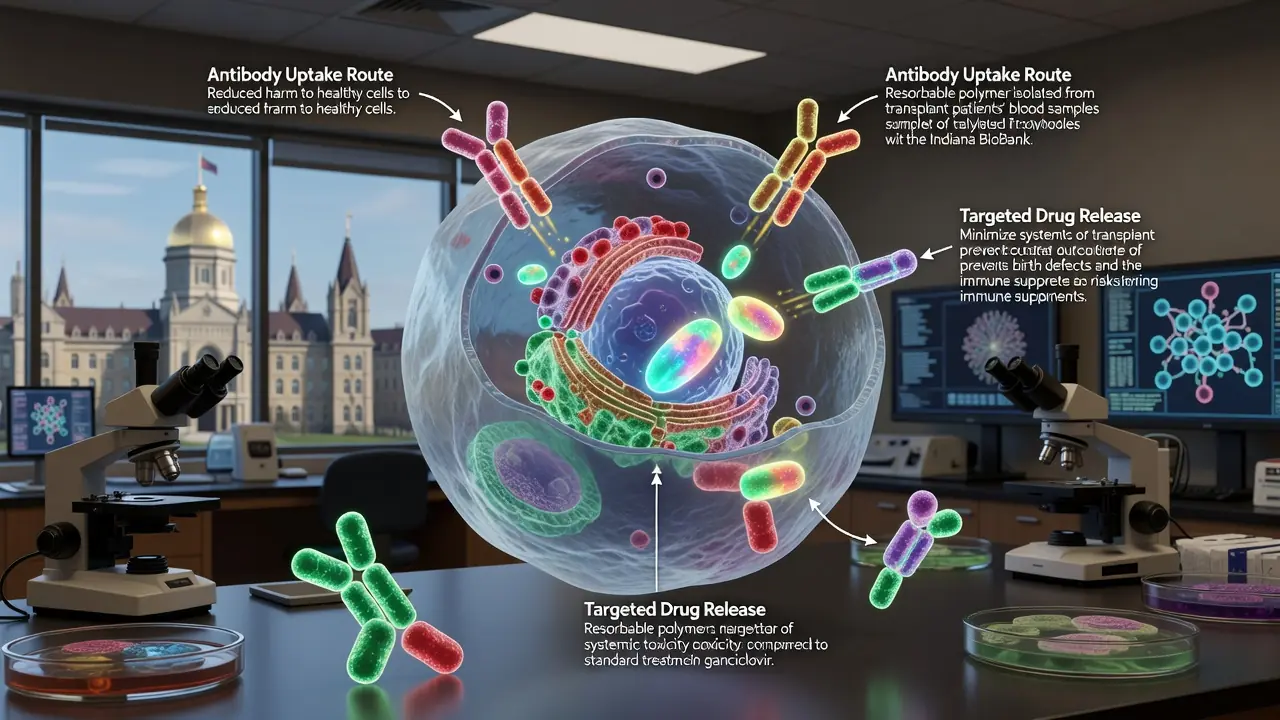
Cytomegalovirus, or CMV, infects most people at some point in life, usually without symptoms. For babies, pregnant women and transplant recipients, however, it can cause severe disease, and researchers at the University of Notre Dame are working on a way to deliver its main treatment more safely.
Why CMV Matters Beyond Its Quiet Reputation
In the United States, about one in three children is infected with CMV by age five, and more than half of adults have been infected by age 40. Most people never notice. Once someone is infected, the virus stays in the body for life and can reactivate when the immune system is suppressed, as it may be during pregnancy or after an organ, stem cell or bone marrow transplant.
Worldwide, CMV is the leading infectious cause of birth defects. A pregnant woman with an active infection can pass the virus to her fetus, and the infection can also raise the risk of miscarriage.
The Limits of the Current Medication
The FDA-approved drug ganciclovir can treat the most dangerous CMV infections. The drug can also be toxic and may build up to harmful levels in the body. For that reason, transplant patients can take it only for limited periods, and it is not recommended for infants or pregnant women.
A Targeted Delivery Approach Under Development
Pilar Perez Romero, an associate professor of biological sciences, and Prakash Nallathamby, a nanoparticle engineer and associate director of the Berthiaume Institute for Precision Health, are developing a laboratory proof of concept. The project is supported by the National Institutes of Health.
The team began by studying antibodies isolated from transplant patients' blood samples, obtained through the Indiana BioBank. They found that CMV-infected cells absorb these antibodies, a defense mechanism that can hide them from the immune cells meant to destroy the virus. The researchers aim to use that uptake route to carry ganciclovir into infected cells. Nallathamby's resorbable polymer nanoparticles, which are made from FDA-approved materials, would encapsulate the drug and release it as they break down.
What Success Would Mean, and What Remains Unknown
If the approach works, it could concentrate the drug inside infected cells and reduce exposure elsewhere in the body, which could lower the risk of toxicity. The main technical hurdle is timing: the particles must reach infected cells before they release their payload. The work is still at the laboratory stage, and the researchers have not yet shown that the approach is safe or effective in patients.